Report
Red Star FC
The club founded by Jules Rimet, sold to an American fund now collapsed, plays in a stadium under judicial restructuring. A second death is possible.
On 21 February 1897, in a café in the seventh arrondissement of Paris, a young man named Jules Rimet founded a football club. He called it Red Star Club français. Twenty-three years later, the same Rimet would become FIFA president and invent the World Cup. His club, for its part, would never become what we today call a great team — but it would become something else, and it is that something else that makes it rare.
The Red Star is one of the oldest football clubs in France. It predates Paris Saint-Germain by seventy-two years. It has survived two liquidations, several wars, a dozen presidents and as many failed mergers. For a century, its identity rested on three things: an old history, a working-class district in the north of Paris, and a brick stadium wedged between railway tracks. All three are today simultaneously under threat.
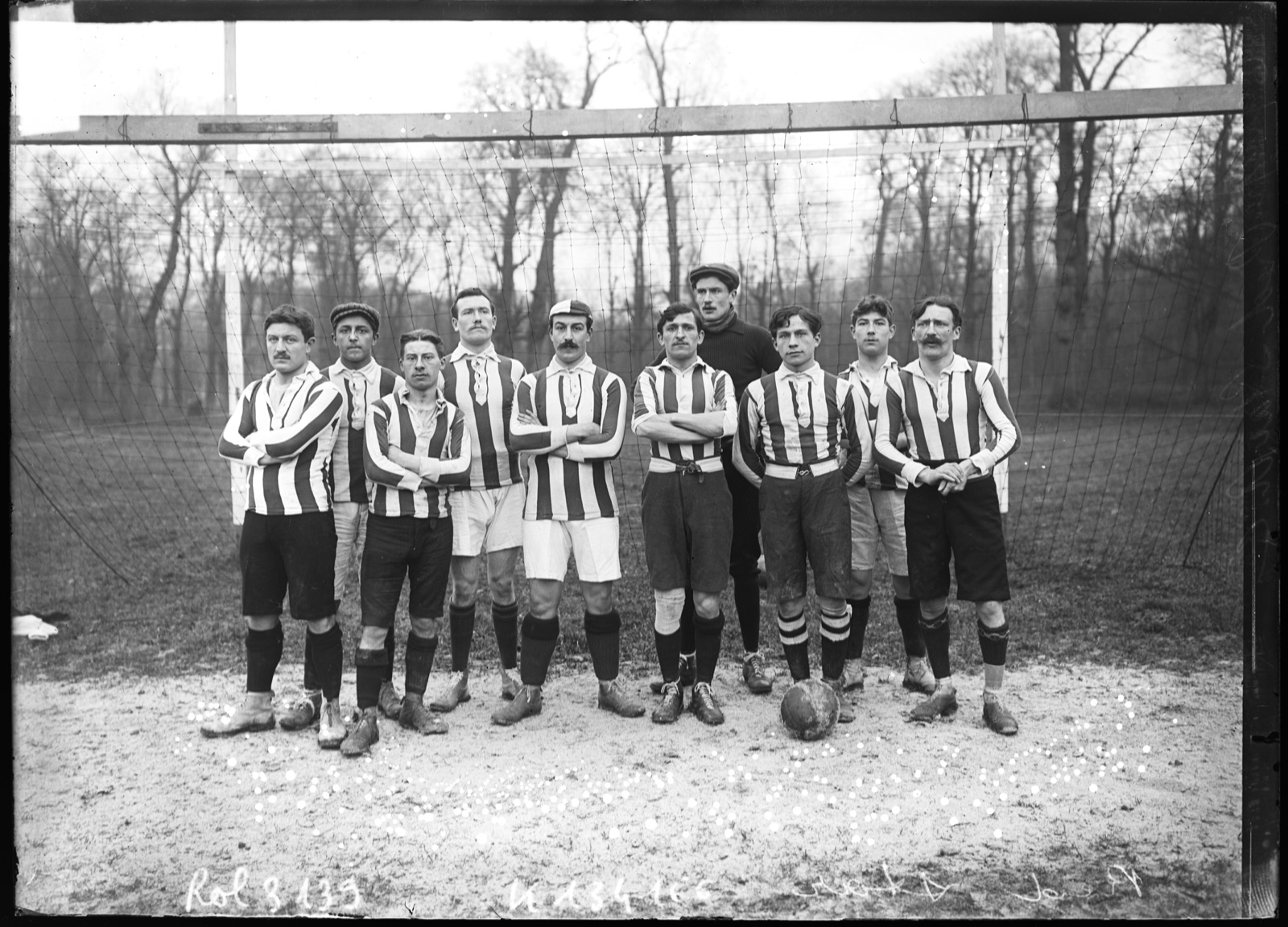
The Red Star squad before a match against Stade français, at Saint-Cloud, in December 1908. Eleven years after Jules Rimet founded the club.
1908 · Agence Rol — Bibliothèque nationale de France, Gallica · Public domain
The forgotten golden age
Between 1921 and 1923, the Red Star won three consecutive Coupes de France. It remains, to this day, the only French team ever to achieve that feat. A fifth Cup followed in 1928, then a sixth in 1942, in the middle of occupation. This record, comparable to what AS Saint-Étienne or Olympique de Marseille would later accomplish, is almost entirely absent from French collective memory. The reason: it belongs to an era when French football had not yet fabricated its own legend, and the Red Star spent most of the following century going down.
In 1909, the club settled in Saint-Ouen, in the working-class suburb north of Paris, and built a pitch there that would become the Stade Bauer. It was there that the club won its titles, hosted the 1924 Olympic Games, and forged the identity that has followed it ever since: a neighbourhood club, popular, left-leaning, stitched together, different by default. The green and white jersey — inherited from a 1926 merger with Olympique de Paris — became a local symbol. The stadium, with its red-brick stands and its angled orientation relative to the pitch, became a place recognisable among all others.
Historical figures
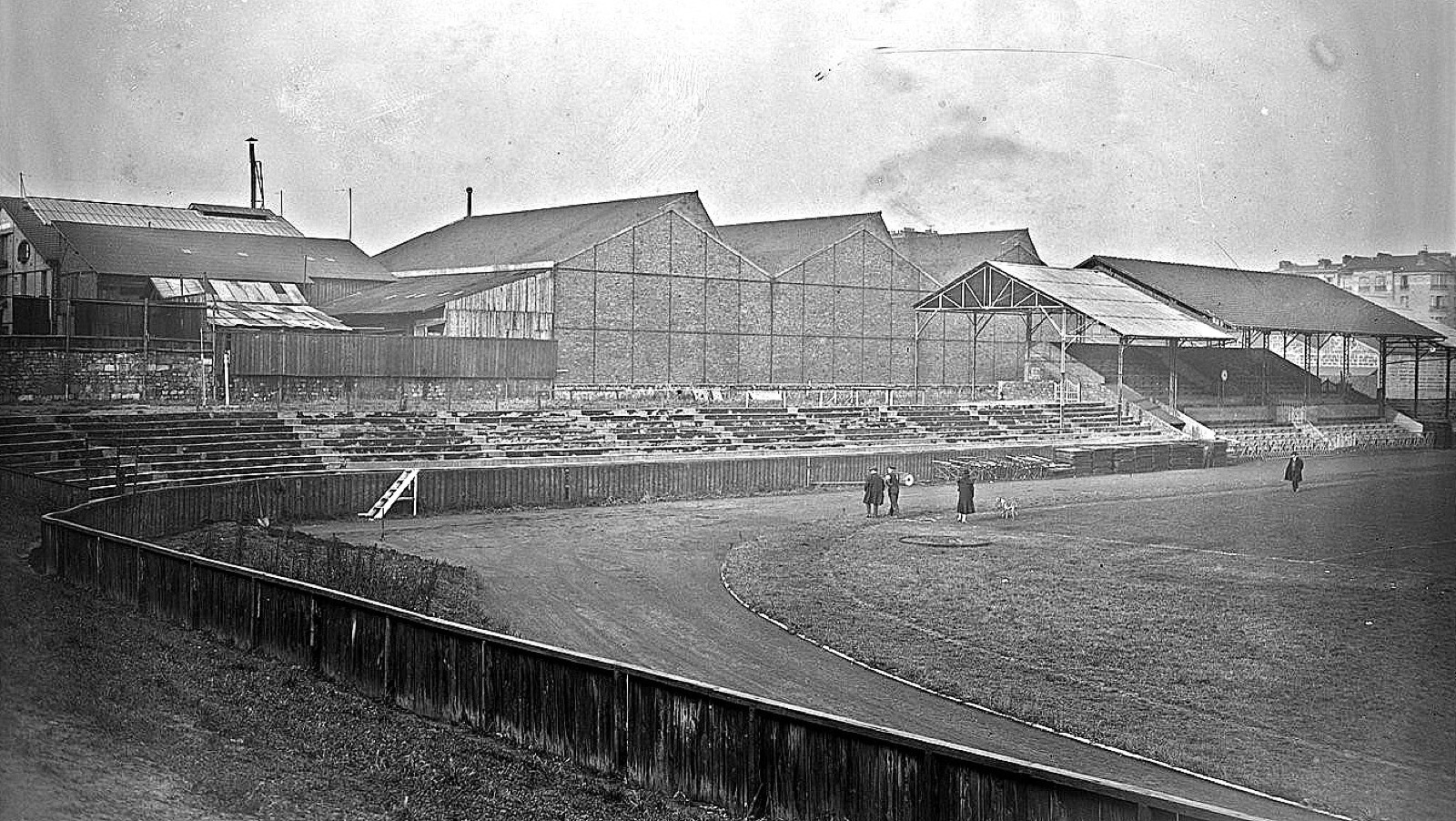
The Stade de Paris — the future Stade Bauer — at Saint-Ouen in 1927. Three seasons after the 1924 Olympic Games, the Red Star is installed in the heart of the working-class suburb north of Paris.
1927 · Agence Rol — Bibliothèque nationale de France, Gallica · CC BY-SA 4.0
Two deaths, several rebirths
The Red Star has already disappeared twice. In 1978, the club filed for bankruptcy and was reborn as the Association sportive du Red Star, starting over from the amateur leagues. In 2003, it was again on the verge of liquidation when a director named Éric Charrier took charge to stabilise what remained. In 2009, the lawyer and businessman Patrice Haddad bought the club and launched a decade of patient recovery: a return to the National league, then to Ligue 2 in 2015 — the first time in sixteen years.
This sawtooth trajectory is the key to the contemporary Red Star. The club has become, through the force of its own collapses, an object of affection. In Saint-Ouen, but also among left-leaning supporters, among football lovers who disliked the industrial transformation of PSG, among visitors who spent an evening at Bauer the way one spends an evening in an old café. This sentimental capital, in 2022, was precisely what attracted an American buyer.
The 777 Partners mistake
In April 2022, Patrice Haddad announced the sale of 100% of the Red Star to 777 Partners, an investment fund based in Miami. 777 was then in the middle of a European club acquisition campaign: Genoa in Italy, Hertha BSC in Germany, Standard Liège in Belgium, Vasco da Gama in Brazil, Melbourne Victory in Australia. The announced model was multi-club ownership: a portfolio of clubs sharing the same capital structure, with circulation of players, data and methods. On paper, the Red Star — small, old, Parisian, in need of rebuilding — found its place there.
Two years later, the edifice collapsed. Beginning in 2024, legal proceedings revealed that 777 Partners had allegedly borrowed more than 350 million dollars from insurer Leadenhall by pledging assets it did not own. The portfolio clubs found themselves in limbo. The Red Star, like the others, waited to learn who its de facto owner was.
Today, that de facto owner is called A-CAP, an American insurance company led by Kenneth King. A-CAP did not buy the Red Star — it inherited it, because it had lent 23 million dollars to a 777 affiliate whose debt has since grown past 350 million. It is an owner by default, through the mechanism of a cascading bankruptcy, not through a sporting project. No A-CAP executive has, to date, publicly laid out a vision for the club.
A popular club is not bought like a financial asset. The Red Star has just learned this the hard way.
The stadium as mirror
The fate of the Stade Bauer follows, almost in unison, that of the club. In May 2021, the city of Saint-Ouen sold the venue to Groupe Réalités, a Nantes-based property developer who committed to rebuilding the stadium in four stands and bringing its capacity to 10,000 by 2027. The east stand was delivered on schedule in January 2024. The smaller south stand followed. And then Réalités collapsed in turn.
In February 2025, the developer was placed in judicial restructuring. A continuation plan was approved by creditors on 20 January 2026, followed by a ruling from the Nantes Commercial Court on 18 February 2026. But the Group's commitment to the two remaining stands — the north, scheduled for summer 2026, and the west, scheduled for 2027 — remains suspended pending the economic viability of its new form. On site, work advances in fits and starts. Saint-Ouen regularly reminds the developer and the club of their commitments, both caught in parallel crises whose outcome neither controls.
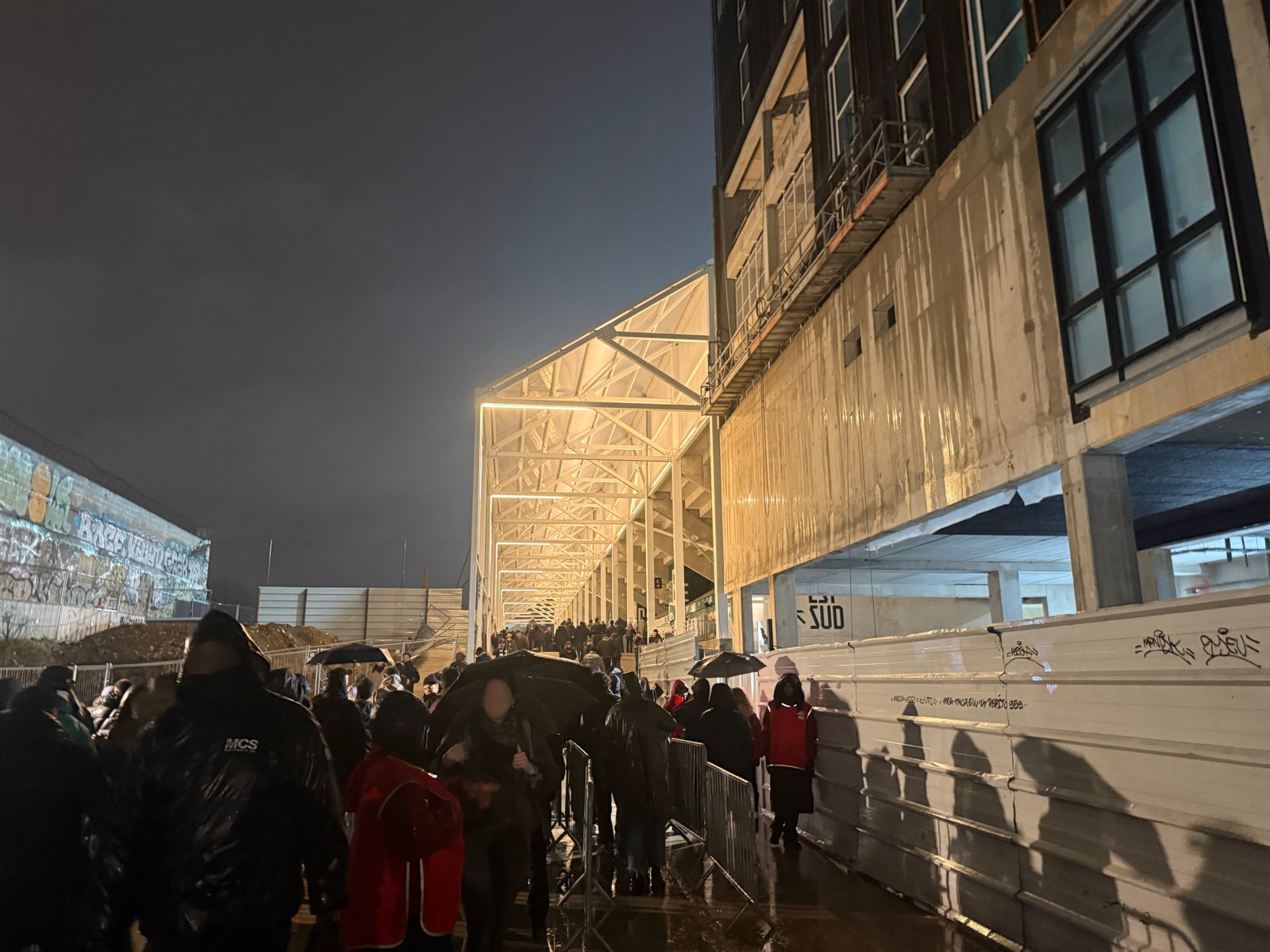
The Stade Bauer on 13 February 2026, five days before the Nantes Commercial Court's ruling on the future of Groupe Réalités. The west and north stands are on hold.
2026 · Chabe01 — Wikimedia Commons · CC BY-SA 4.0
What the case tells us
The Red Star and Paris FC are the two professional football clubs of the French capital. For a long time, they shared the same quiet fate. Since 2022, their trajectories have diverged radically, and the divergence says something about the way private capital is arriving in European football today.
Paris FC was bought in 2024 by Bernard Arnault's Agache holding, alongside Red Bull as operating partner. It is a structured arrangement: a patrimonial shareholder with a global brand, a specialised sporting operator, a declared timeline. The Red Star, for its part, was sold to a buyer who had neither the solidity nor the intention to hold, and who collapsed eighteen months later. The club now belongs to an American insurer by legal default.
Multi-club ownership, which in five years has become the dominant fashion in world football, rests on a simple promise: pool the risks. The Red Star case shows the other face of the promise — when the portfolio collapses, it is the most fragile, most identity-laden, least self-defensible clubs that pay the heaviest price. PSG has a state behind it. Genoa has an Italian history and a city that holds it. The Red Star has Saint-Ouen and a stadium under construction.
If the Red Star survives this decade — and it has already survived worse — it will be because its sentimental capital held on long enough for the legal structure to untangle. If a real patrimonial takeover emerges, it will come from elsewhere: perhaps from Saint-Ouen itself, perhaps from a buyer who understands that a popular club is not bought like a financial asset. For now, that buyer does not exist.