Report
Parma Calcio 1913
Rebuilt after one of Europe's greatest financial frauds and three consecutive bankruptcies, the historic Emilia-Romagna club has belonged since 2020 to an American from Iowa whose great-grandparents were born in Sicily.
In December 2014, Parma Foot Ball Club, which had won eight major trophies between 1992 and 2002 — three Coppa Italias, two UEFA Cups, one Cup Winners' Cup, one European Super Cup and one Supercoppa italiana — was sold for one euro. The buyer was a Cypriot holding company controlled by a businessman named Rezart Taçi. Two months later, in February 2015, Taçi resold it, also for one euro, to Giampietro Manenti. In March 2015, Manenti was arrested for money laundering. In June of the same year, Parma was officially declared bankrupt, with two hundred and eighteen million euros in debts — of which sixty-three million were unpaid wages.
A decade later, in May 2024, the same Parma — refounded, bought, bought again — was promoted back to Serie A. Its owner is an American from Iowa who made his fortune in a chain of convenience stores and whose paternal grandmother spoke Sicilian. This report is about how one goes from one state to the other.
The Parmalat age
Parma was founded in July 1913 under the name Verdi Foot Ball Club, to celebrate the centenary of the birth of Giuseppe Verdi, who was born in the neighbouring province. A few months later, a competing club — Parma Foot Ball Club — adopted the white colours with a black cross, which are still those of the club today. The two entities merged over the years, and it is this second structure that has survived. For three quarters of a century, Parma remained an Emilia-Romagna club without major titles, alternating between lower divisions and brief appearances in Serie A.
Everything changed in 1991, when Parmalat, the dairy multinational based in Collecchio a few kilometres from Parma, bought the club. At its head, the Tanzi family saw football as a tool of international visibility for the brand, and started spending. The result was immediate: the Coppa Italia in 1992, the Cup Winners' Cup in 1993 against Antwerp at Wembley, the UEFA Cup in 1995 against Juventus, the Coppa Italia again in 1999, the UEFA Cup again the same year against Marseille, the Supercoppa italiana in 1999, and another Coppa Italia in 2002. In ten years, Parma became one of the most titled clubs in Europe, with a squad that included at various points Hernán Crespo, Gianluigi Buffon, Lilian Thuram, Fabio Cannavaro, Hidetoshi Nakata. For a while, the team was even spoken of as the fourth force of Italian football after Juventus, Milan and Inter.
Then, in December 2003, the structure collapsed. Parmalat, whose books had been doctored for years, was caught in flagrant accounting fraud. The group's real debt was estimated at more than fourteen billion euros — one of the largest corporate frauds ever documented in Europe, compared at the time to Enron. In April 2004, Parma entered judicial administration, with an annual deficit of one hundred and sixty-seven million euros of its own. The decade that followed was one of slow decline.
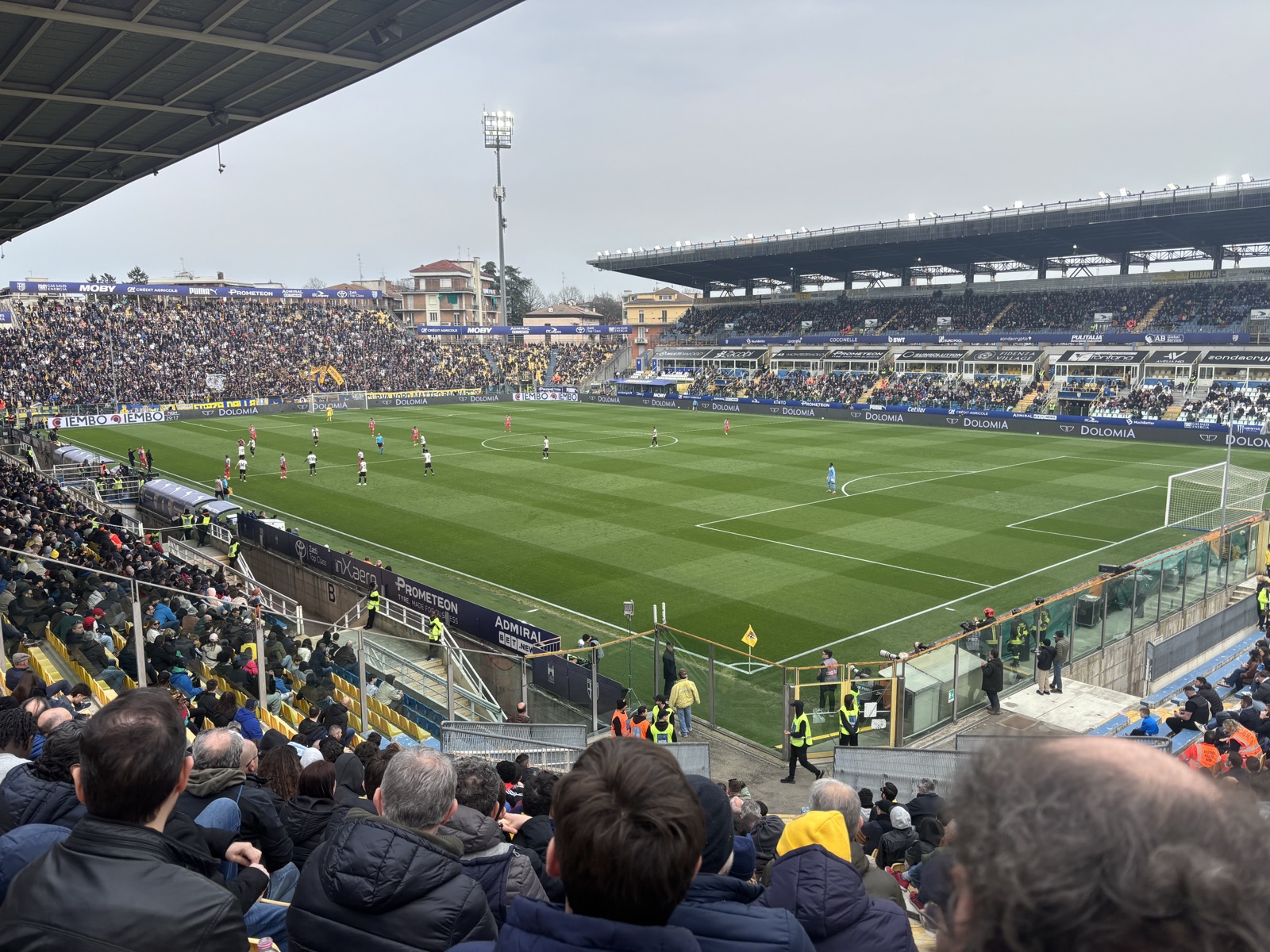
The Stadio Ennio Tardini in March 2026, a century after Parma moved to this pitch in 1923. The stadium is today at the centre of the renovation project led by the American ownership.
Three bankruptcies in eleven years
On 24 January 2007, after three years of judicial administration, the club was bought by Tommaso Ghirardi, a young Italian entrepreneur in engineering, for approximately thirty-nine million dollars. Under Ghirardi, Parma stabilised for a few seasons in Serie A, then began losing money again. In December 2014, unable to pay its players or its suppliers, Ghirardi sold the club's majority — sixty-six percent — to a Cypriot holding, Dastraso Holding, controlled by Rezart Taçi, for a symbolic one euro.
Taçi held for two months. In February 2015, he resold to Giampietro Manenti, also for one euro. Manenti, presented at the time as a foreign investor, was arrested the following March for money laundering activities linked to previous dealings. The club ran for a few weeks without real direction, with unpaid players and suppliers who refused to deliver. On 22 June 2015, the Parma court ordered judicial liquidation. The official debt was two hundred and eighteen million euros.
On 22 July 2015, a group of local industrialists founded a new entity, S.S.D. Parma Calcio 1913. Among the founders: Guido Barilla — heir to the pasta empire —, Paolo Pizzarotti — head of the construction group Impresa Pizzarotti — and Giampaolo Dallara — builder of racing car chassis. The project was explicitly civic: save the club's identity, start from scratch, accept to play in Serie D if that was the price. Parma dropped four divisions at once.
What followed was unusual: Parma went up three times in a row. From Serie D to Lega Pro in 2016. From Lega Pro to Serie B in 2017. From Serie B to Serie A in 2018. It was the first time in the history of Italian football that a club strung together three consecutive promotions. Nobody, from the outside, expected that a civic rescue project would hold, and it did.
Key figures
The American from Iowa
In September 2020, Parma had a new owner. Kyle Krause, chairman and CEO of the Krause Group, based in Des Moines, Iowa, bought ninety percent of the capital. The Krause Group is a family conglomerate whose historical business is Kum & Go, a chain of convenience stores with gas stations — roughly four hundred outlets across the American Midwest. But the company also has activities in Italian wines (notably in Tuscany), real estate, agriculture, and logistics. The purchase of Parma does not, therefore, come entirely out of nowhere.
Kyle Krause has a coherent personal narrative: his paternal grandmother and her parents were born in Palermo, Sicily, and he presents himself as an Italian-American. He has also owned, since 1998, a semi-professional American club, Des Moines Menace, which twice won the USL championship and entered the league's Hall of Fame in 2011. Buying a historic European club is not, in his discourse, a financial operation; it is the fulfilment of a personal project, exactly as in the case of the Hartono brothers at Como, and exactly opposed to the portfolio logic of 777 Partners at Red Star.
Three years after the purchase, in June 2023, the Krause Group bought the remaining ten percent held by the local Nuovo Inizio industrialists and became owner at ninety-nine percent of Parma. The transition from civic shareholding to American shareholding was then complete.
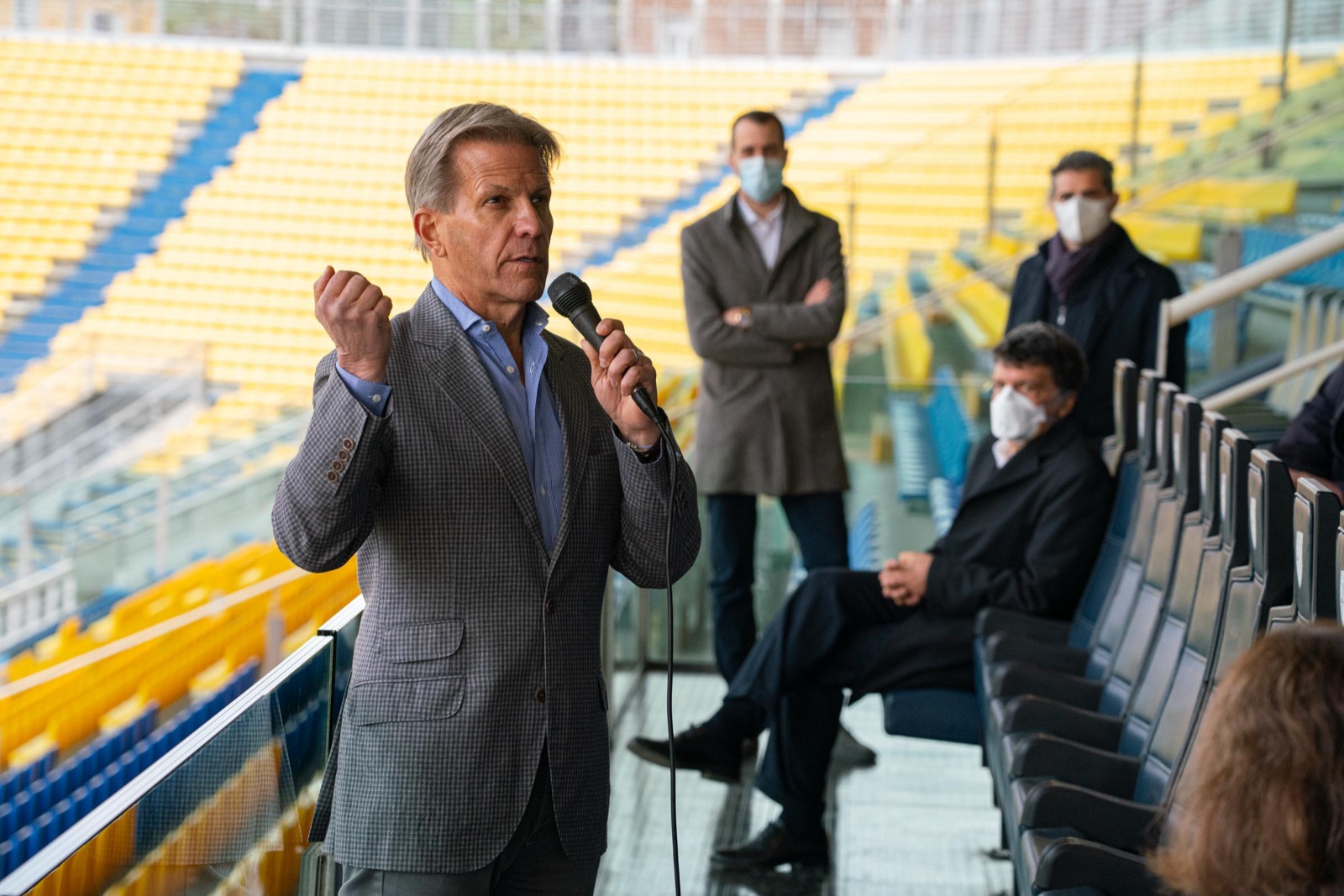
Kyle Krause, chairman and CEO of the Krause Group, presenting the Stadio Tardini renovation project in April 2021, six months after buying Parma.
The return
Under Krause, Parma spent three seasons in Serie B before going back up. On 1 May 2024, the club sportingly secured its promotion to Serie A. The 2024-25 season was its first in the elite after four years away, and the club finished sixteenth out of twenty — a survival secured without glory but without drama. On the scale of what Parma lived through between 2003 and 2018, it is a total success.
Krause's attention has also turned to infrastructure. As early as April 2021, he announced a complete renovation project for the Stadio Tardini, whose structures date from 1923 and had not been modernised in decades. The project has seen administrative back-and-forth with the municipality of Parma and the heritage authorities — the stadium is partially listed — but remains one of the declared construction sites of the new American ownership.
Buying a historic European club is no longer the preserve of funds. It has become, for certain wealthy families, a personal narrative to be realised.
One hundred and thirteen years in ten dates
- 1913
Club founded
Verdi Foot Ball Club is founded in July, for the centenary of the birth of Giuseppe Verdi. Quickly renamed Parma Foot Ball Club.
- 1991
Parmalat buys the club
The dairy multinational of the Tanzi family, based in Collecchio, takes control of the club and finances a decade of massive investment.
- 1992-2002
Eight trophies in ten years
3 Coppa Italias, 2 UEFA Cups, 1 Cup Winners' Cup, 1 European Super Cup, 1 Supercoppa italiana. One of the most titled decades in Italian football.
- December 2003
Parmalat collapse
The accounting fraud of the parent company is revealed — one of the largest European corporate frauds. Parma enters judicial administration in April 2004.
- 2007
Bought by Ghirardi
The Italian entrepreneur Tommaso Ghirardi takes over the club after three years of administration. The project holds for eight years before collapsing in turn.
- 2014-2015
Three sales in six months
Ghirardi sells to Dastraso Holding for €1, who resells to Manenti for €1, who is arrested. Official bankruptcy in June 2015 with €218 M in debts.
- July 2015
Civic refoundation
Guido Barilla, Paolo Pizzarotti, Giampaolo Dallara and other local industrialists refound the club under the name S.S.D. Parma Calcio 1913, in Serie D.
- 2016-2018
Three consecutive promotions
First time in the history of Italian football: Serie D → Lega Pro → Serie B → Serie A in three seasons.
- September 2020
Bought by Krause Group
Kyle Krause, based in Iowa, buys 90% of the club. The Krause Group rises to 99% in June 2023.
- May 2024
Return to Serie A
Parma secures promotion to the Italian elite, four years after its previous relegation. The 2024-25 season ends in sixteenth place.
What the model tells us
Krause's Parma is, in the new cartography of private capital in European football, one of the cases closest to Como 1907: a personal owner with a patrimonial fortune, who buys an affordable historic club — Parma cost a little less than Como, but both remain far below Premier League club prices — and leads it slowly upward. Like Como, the project has a family narrative at its origin: Krause cites his Sicilian roots in almost every interview. Like Como, it is not backed by a fund seeking a short-term return on investment.
Where it differs is in its own history. The Hartono Como was bought at a low point, without a great mythology to rebuild — the 1930-31 season is distant, and nobody, in Como, asks the Hartonos to erase a collective trauma. Parma, on the other hand, was bought with the echo of the Parmalat collapse still present. For part of the supporter base, the American buyout is less an opportunity than a question: will the project last this time?
The transferable lesson of the Parma case is probably this: a historic European club can be completely destroyed by a major bankruptcy and rebuilt from a civic refoundation, but that civic refoundation has a limited lifespan. At some point, the refounded club needs a structuring investor to take over from the local notables. For Parma, that relay was the American from Iowa. For other European clubs in a comparable situation — and there are several in Italy, in France, in Spain — the question is whether they will find theirs, and whether they will have the time.