Report
Union Saint-Gilloise
Ninety years after its previous title, the Brussels club won the 2025 Belgian championship. Behind the resurrection: a professional English gambler, a statistical analysis company, and patience.
On 25 May 2025, Royale Union Saint-Gilloise beat La Gantoise three to one at the Stade Joseph Marien, in Forest, in the southern part of Brussels. The result closed the final phase of the Belgian championship and gave the club its twelfth national title. The previous one dated from 1935. Ninety years between two trophies — one of the longest waits documented in European football.
The Union had never quite left Belgian memory, but it had slipped out through the back door. For eight decades, the club, founded on 1 November 1897, moved from the top division to the second, from the second to the third, brushing several times against outright disappearance. It only returned to the top flight in 2021, after a promotion won in the second division. Four seasons later, it was Belgian champion.
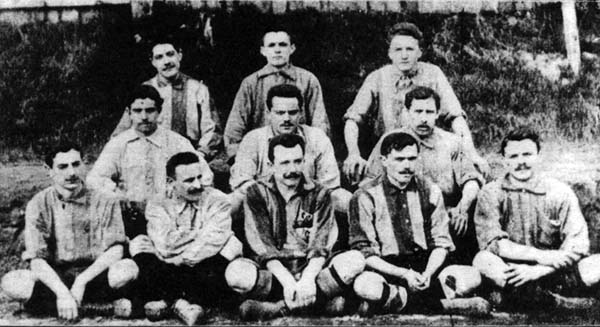
The Union Saint-Gilloise squad during the 1903-1904 season. That year, the club won the first of eleven national titles that would stretch until 1935.
1903-1904 · Union saint-gilloise — Wikimedia Commons · Public domain
The golden age, then the fall
Between 1904 and 1913, the Union won seven titles in ten seasons. Three more followed in the thirties — 1933, 1934, 1935 — making eleven titles in thirty-one years. At the time, it was the most titled club in Belgian football. It opened its stadium, the Parc Duden, just after the First World War, and renamed it in 1931 the Stade Joseph Marien, after a former president. The yellow and blue colours were then known throughout the country.
Then everything stopped. The 1935 title was the last, and nobody knew it. From the late thirties, the Union declined slowly, joined the mid-table of the Belgian championship, slipped to the second division in 1949, came back up, went down again, until it spent most of the 1980s and 1990s in Promotion or in Division 3. The club remained semi-professional until 1984. In every generation, there was talk of administrative relegation, of bankruptcy, of merger with a neighbour. The Stade Joseph Marien — which had held 18,000 spectators in the thirties — aged without anyone renovating it.
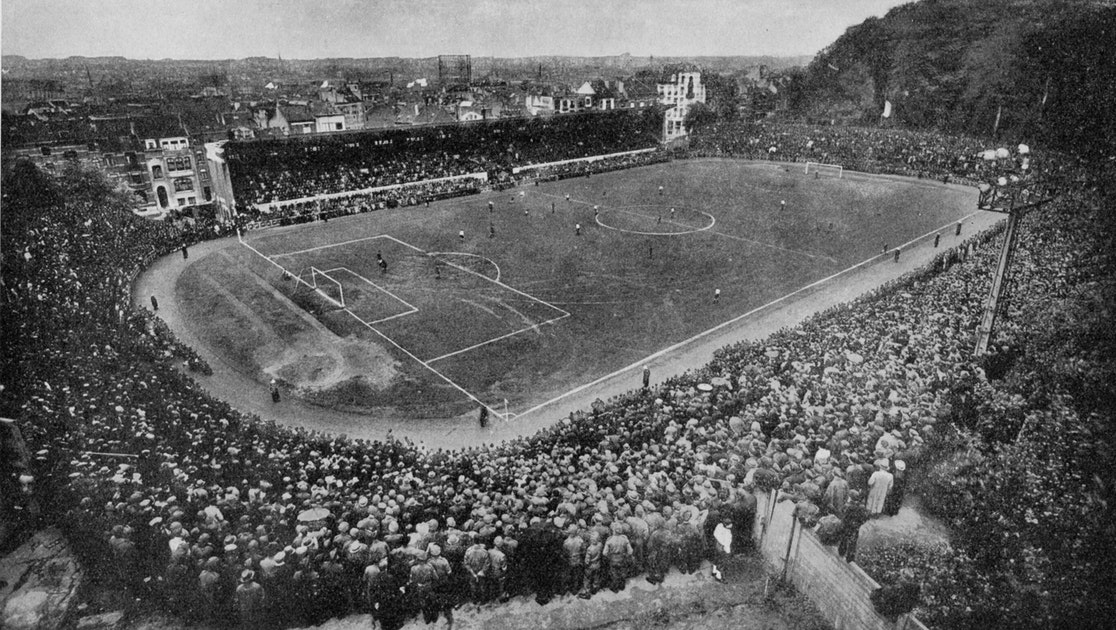
The Stade Joseph Marien in the 1930s, during a match against Daring Club de Bruxelles. At the time, the stadium could hold nearly three times its current capacity.
1930s · Miroir des Sports — Wikimedia Commons · Public domain
Key figures
Tony Bloom arrives
In 2018, the Union was in the Belgian second division, with no particular sporting project, and had long belonged to local directors who had neither the means nor the strategy to bring the club back up. That year, a discreet Englishman named Tony Bloom bought the club.
Bloom is not an ordinary football investor. He is, first and foremost, a professional gambler — one of the most successful in the history of sports betting. In 2006 he founded a statistical analysis company called Starlizard, whose business is to model the outcome of football matches to optimise betting positions. He has also owned, since 2009, Brighton & Hove Albion, which he has taken from the English third division to the Premier League using the same methods: data-driven recruitment, systematic identification of undervalued players, patience.
The 2018 purchase of the Union is explicitly presented as an extension of the Brighton experiment to a new market. No grand plan, no promise of Champions League: simply the methodical application of a system. The president is Alex Muzio, a long-time associate of Bloom and a regular contributor at Starlizard. The chief executive is Philippe Bormans. The structure is compact, documented, aligned.
The method
From 2018 to 2021, the Union did not do much visible. The club consolidated its structure, recruited its first Starlizard-identified players, and prepared to go back up. In 2020, Felice Mazzu was appointed head coach. In 2021, the Union won the Belgian D2 championship and climbed to Division 1A. Nobody, from the outside, expected much from them.
And then, in their first season in the top flight, they finished second. In the second, third. In the third, second again — and won the Belgian Cup in 2024. In parallel, the Union played every year in European competition: Europa League quarter-final in 2023, Europa Conference League round of sixteen in 2024, playoffs of the next round in 2025. Five head coaches succeeded one another in five years — Mazzu, Geraerts, Blessin, Pocognoli, Hubert — without the trajectory changing. The club's identity is not held together by a coach; it is held by the structure behind them.
In May 2025, they won the title. The following season, they entered the Champions League group stage — for the first time in fifty-eight years.
Five coaches in five years, each year higher than the last. The permanence here is not human — it is statistical.
The UEFA problem
In 2023, the Union and Brighton were drawn into the same Europa League round. Direct confrontation is forbidden by UEFA: its Article 5 prohibits the same owner from holding two clubs in competition during the same season, in order to preserve the tournament's sporting integrity. Bloom was told to choose.
His answer was a legal arrangement: he transferred the majority of his shares to Alex Muzio, his Starlizard partner, who officially became the majority owner. Bloom remained a minority shareholder and kept his informal strategic role. For UEFA, formally, the Union and Brighton no longer shared the same owner. For the market, everyone knew nothing had really changed. The two clubs continued to share the same analytical infrastructure, the same recruitment methods, the same ideas about football.
Fifteen years of transformation
- 2018
Tony Bloom buys the club
The Brighton owner and Starlizard founder buys the Union in the Belgian second division. Alex Muzio becomes president, Philippe Bormans chief executive.
- 2020
Felice Mazzu appointed head coach
The Belgian coach takes charge and secures promotion to Division 1A at the end of the 2020-21 season.
- 2021
Back in Division 1A
D2 champions, the Union return to the Belgian top flight after forty-eight years of absence.
- 2022
Runners-up in their first season
In their first season back in the top flight, the Union finish second, one point behind Club Brugge. First European qualification.
- 2023
Ownership restructuring
Drawn against Brighton in the Europa League, Bloom transfers the majority of his shares to Alex Muzio to comply with UEFA rules.
- 2024
Belgian Cup and Super Cup
First major trophy since 1914: the Union wins the Belgian Cup, followed by the Super Cup at the start of the next season.
- May 2025
Belgian champions
Ninety years after its last title, the Union wins the Belgian championship by beating La Gantoise 3-1 at the Stade Joseph Marien.
- 2025-26
Champions League group stage
First participation in the group stage since 1968 — fifty-eight years of waiting.
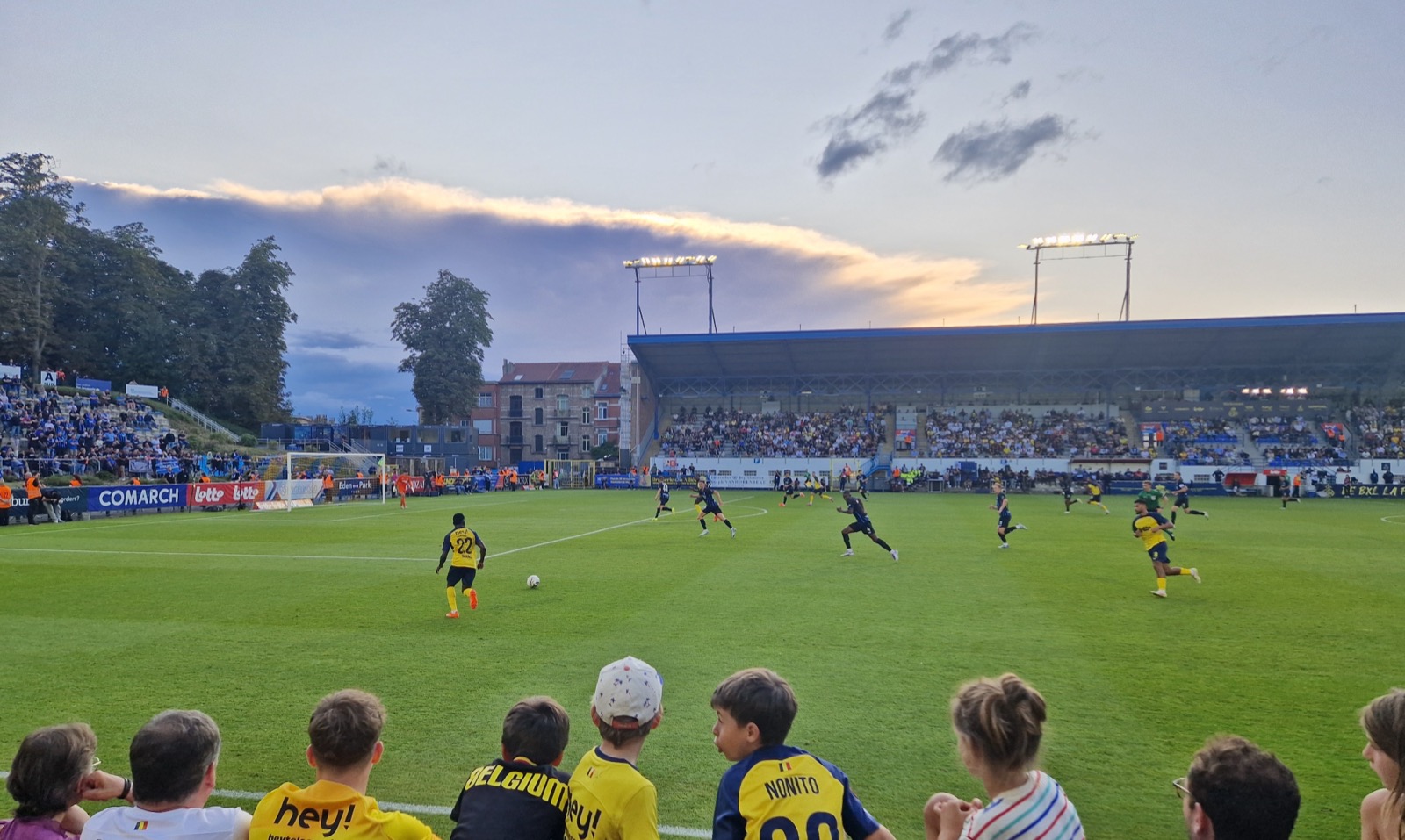
The Belgian Super Cup, July 2025. Union Saint-Gilloise's first official match as defending national champions, ninety years after its predecessor.
What the model tells us
In the landscape of European club takeovers over the last seven years, the Union Saint-Gilloise case is the only clear example of a multi-club ownership arrangement that has actually worked. 777 Partners collapsed into fraud. Manchester City's City Football Group accumulates uneven results despite its means. Red Bull, which draws the most frequent comparisons, is massively better capitalised and yet has never transformed a club as quickly as Bloom has transformed the Union.
The difference probably comes down to three things. First, unity of method: Brighton and the Union share the same analytical infrastructure, the same scouting model, the same philosophy of recruiting young and undervalued players. Second, patience: seven years between the purchase and the title, with no political pressure to accelerate, because the owner does not depend on football for his income. Third, the absence of a brand to protect: Bloom does not need the Union to become famous in order to validate anything else in his life. He was right on the numbers; he showed it without needing to shout about it.
For other European clubs watching the case, the transferable lesson is not "you need a billionaire" — there are already plenty, and most fail. It is rather "you need a unique method, applied long enough to produce results." The exact opposite of what 777 Partners attempted, buying eight clubs in two years without having the time to understand any of them.
The other lesson, more subtle, concerns the relationship between data and identity. Today's Union has almost nothing to do with the Union of 1935, except the name, the jersey and the stadium. Almost all the players arrived in the last five years, recruited by algorithm. And yet, in Forest, in the streets around the Stade Joseph Marien, people talk about them as the return of an old king. Data rebuilt a club, and supporters rebuilt the narrative around it. Neither process is top-down.