Report
Paris FC
Fifty-six years after its accidental birth, Paris's second football club is back in Ligue 1, owned by the Arnault family and Red Bull, and has beaten PSG at the Parc des Princes for the first time in forty-seven years.
On 12 January 2026, in the round of thirty-two of the Coupe de France, Paris FC walked into the Parc des Princes to face Paris Saint-Germain. After seventy-four minutes, Jonathan Ikoné scored. The match ended one to zero for the visitors. It was Paris FC's first official victory over PSG since the 1978-79 season. Forty-seven years between two results.
To grasp what that evening meant, one has to accept a counter-intuitive fact: Paris FC and PSG were born from the same event. In 1970, Paris FC merged with Stade Saint-Germain and gave birth to Paris Saint-Germain. Two years later, in 1972, the merger broke apart. One fragment inherited the professional structure and kept the Paris FC name. The other took the amateur structure and kept the Paris Saint-Germain name. Fifty-four years later, the second owns Neymar and half the Ballons d'Or of the decade. The first has just been promoted to Ligue 1 for the first time since 1979.
An accidental birth
Paris FC was not truly born of a founder's will. It was born of an absence. In the late 1960s, several historic Parisian clubs disappeared from professional football — Racing Club de France in 1966, CA Paris in 1963, Stade français in 1968. For the leaders of the French Football Federation, including Fernand Sastre and Henri Patrelle, the French capital needed a first-rank club. Paris FC was founded on 13 December 1969 with that purpose in mind, as a vehicle.
The promoters of the new club quickly ran into a practical problem: not enough players, not enough structure, not enough money. The solution took the form of a 1970 merger with Stade Saint-Germain — a suburban club run by Henri Patrelle — which created Paris Saint-Germain. The structure held for two years. In May 1972, the Paris city council voted 46-44 to demand the club simply be called "Paris FC" as a condition for access to the Parc des Princes and municipal funding. PSG refused, walked away, rebuilt around an amateur core — and eventually became what it is today. Paris FC kept the professional structure, the Parc des Princes for two seasons, and a decade of decline ahead of it.
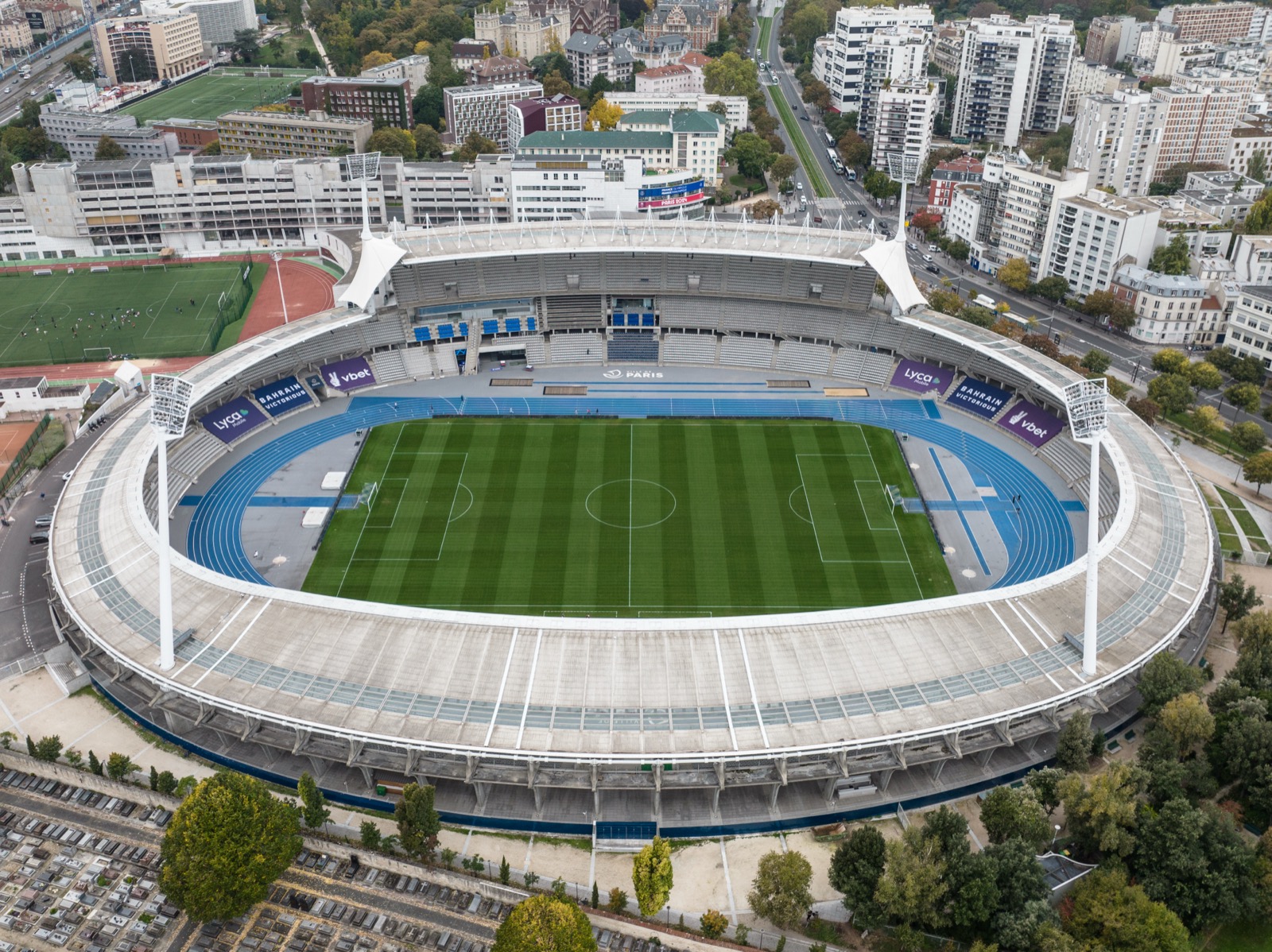
The Stade Charléty, in the thirteenth arrondissement, where Paris FC played its home matches from 1999 to 2025. Twenty-six seasons of discretion in a capital dominated by a single name.
2022 · Arne Müseler — arne-mueseler.com · CC BY-SA 3.0 Germany
Fifty years of discretion
From 1972 to 2024, Paris FC played fifty-two seasons without ever returning durably to the elite. The club changed names almost every decade: Racing Paris 1 under Jean-Luc Lagardère in the eighties, Paris FC 83, Paris FC 98, Paris FC 2000, before reverting to its original name in 2005. This ballet of brands tells a story of underlying instability — each new president tried to start from scratch, and each attempt eventually ran out of steam. The club moved through the Parc des Princes, the Stade Déjerine, the Stade Charléty, without ever identifying durably with any of them.
In 2015, Pierre Ferracci, a businessman and media owner, bought the club and began a decade of patient reconstruction. Paris FC settled in Ligue 2, regularly finishing in the middle of the table or at the top, playing for promotion without ever securing it. It was under Ferracci that the club began to look like a credible proposition — not a great club, but a sound investment. On 2 May 2025, after a season finishing second in Ligue 2, Paris FC was promoted to Ligue 1 for the first time since 1979. In the summer, it moved to the Stade Jean-Bouin, one kilometre from the Parc des Princes.
Key figures
The arrival of capital
On 17 October 2024, Bloomberg reported that the Agache holding — the Arnault family's personal structure, distinct from LVMH — was preparing to take a majority stake in Paris FC. On 29 November, the deal was officially closed. The resulting capital structure is rare in French football:
- Agache Sport (Arnault): 52.4%
- Alter Paris (Pierre Ferracci): 29.8%
- Red Bull: 10.6%
- BRI Sports Holdings: 7.2%
Ferracci's stake, who until then had been the sole shareholder, is held as a transition. According to the announced terms, the Arnault family plans to buy out his shares in 2027, which would bring its total stake to over 82 percent. Pierre Ferracci remains as president to ensure continuity.
Red Bull's role is explicitly secondary in capital but central in operations. This is the Austrian company's sixth football club acquisition — after Salzburg, Leipzig, New York, São Paulo (Bragantino) and a minority investment at Leeds. Red Bull does not just bring money: it brings a documented know-how in turning second-tier clubs into clubs that matter. The agreement provides that it plays this role at Paris FC without legally holding the majority.
Half a century of owners
- 1969
Founded by the FFF
Fernand Sastre, Henri Patrelle and Guy Crescent create Paris FC to fill the absence of a major professional club in Paris.
- 1970–1972
Merger and split with PSG
The merger with Stade Saint-Germain gives birth to PSG. A Paris city council vote in May 1972 splits the two entities.
- 1982
The Lagardère era
Jean-Luc Lagardère buys the club and renames it Racing Paris 1, in an attempt to merge with Racing Club de France. The operation collapses in 1989.
- 2015
Pierre Ferracci takes over
The businessman and media owner acquires the club and engages in a decade of Ligue 2 stabilisation.
- Oct.–Nov. 2024
Agache and Red Bull enter
The Arnault family holding takes 52.4%, Red Bull 10.6%. Ferracci remains as transitional shareholder with 29.8%.
- May 2025
Promotion to Ligue 1
Runners-up in Ligue 2, the club earns promotion to Ligue 1 for the first time since 1979 — forty-six years absent.
- Jan. 2026
1-0 win over PSG
In the Coupe de France round of thirty-two, at the Parc des Princes, goal by Jonathan Ikoné. First official win over PSG since 1978-79.
The night at the Parc
What was played at the Parc des Princes on the evening of 12 January 2026 was not a sporting result. Paris FC will not become French champions this year, nor win the Coupe de France, nor rival PSG over the length of a season. On ninety minutes, the hierarchy can invert; on ten months of championship, it does not. But what was played that evening was symbolic in the strong sense of the word: the sudden possibility of speaking about Parisian football in the plural again.
What the victory signals is that an investment barely fifteen months old is already producing visible effects. Not yet systemic, not yet secured — but visible. The Paris FC that walked into the Parc on 12 January 2026 could not have done so in January 2024.
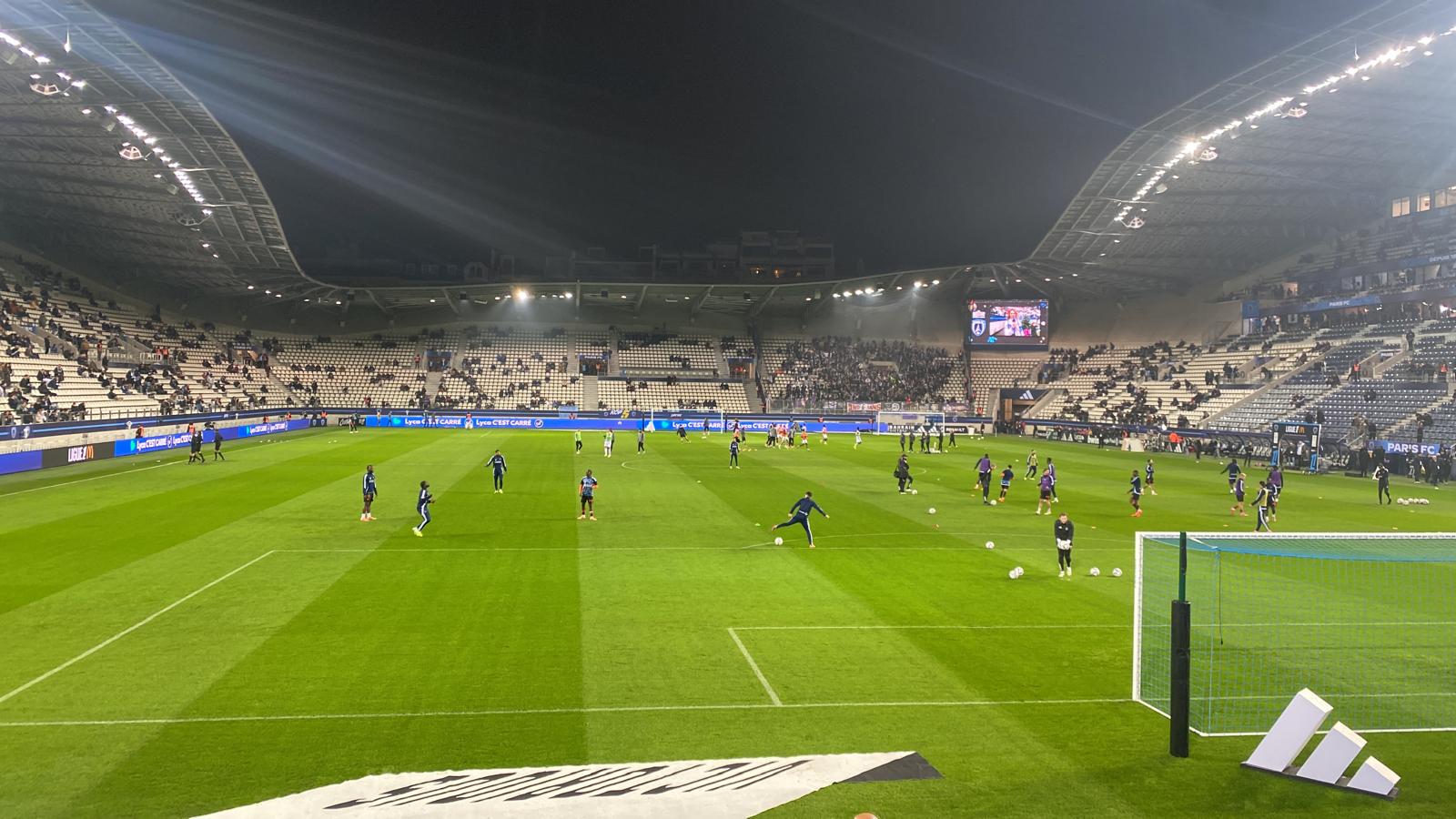
A Paris FC match at the Stade Jean-Bouin in December 2025. The club's first season in its new stadium and in the top flight.
What the model tells us
Paris FC's acquisition is one of the most finished examples of what could be called the new phase of private capital in European football. It is not an opaque consortium, nor a sovereign wealth fund, nor an American-style multi-club ownership arrangement. It is a two-headed structure with clear roles: a patrimonial shareholder with a global brand on one side, a specialised sporting operator on the other. Arnault brings the capital, the French respectability, the brand; Red Bull brings the method and the experience accumulated in Salzburg, in Leipzig, in New York.
This division of labour is what makes the model interesting. Owning a football club and knowing how to make it win are two different trades. For a long time, European club owners have tried to do both at once, with mixed results. The Paris FC model suggests that this separation can now be structured explicitly, contractually, from the outset.
The bet is legible. If Red Bull succeeds in turning Paris FC into a stable, competitive Ligue 1 club over three or four seasons, Paris will cease to be a one-club city. That is less likely than it seems, because PSG's dominance is funded by a state. But it is more likely than anything that has been attempted before.
Owning a football club and knowing how to make it win are two different trades. Paris FC has just structured that separation.
For the rest of Europe, the interest of the case lies elsewhere. It suggests that the next major club acquisitions could follow this pattern: a patrimonial owner with a strong brand paired with a specialised operator, rather than the multi-club funds that dominated the previous decade — and that, as the collapse of 777 Partners has shown, know how to buy without always knowing how to hold. The Paris FC model, if it works, will be the one others try to imitate.