Report
FC Nordsjælland
The only European football club purchased by an African academy, itself now the European tip of a system that begins in Ghana and ends in the Premier League.
In December 2015, a Danish Superliga club acquired a new owner. That buyer was unusual in several ways: it was registered in Ghana, it was legally a non-profit, and its main business was not to run football clubs but to educate children. It was the first time — and to date the only time — that a European club passed under the control of an African educational structure. The club was FC Nordsjælland. The buyer was Right to Dream.
Five years later, in 2021, that same Right to Dream was itself bought — for one hundred million euros — by an investment arm of the Mansour Group, an Egyptian family conglomerate. The Danish club then became the tip of a much wider device: a vertical system that begins in a residential academy in Accra, passes through a second-tier European club, and aims explicitly to place its players at the top of world football. This report is about that device, and about what it says about what a European club can become when its role is to serve as a passage.
The club before the project
FC Nordsjælland was born on 1 January 1991 from the merger of two local clubs in northern Sjælland — Farum Idræts Klub (founded 1910) and Stavnsholt Boldklub (founded 1974). For twelve years, the entity was simply called Farum BK. In March 2003, under the impulse of Danish businessman Allan K. Pedersen, the club was renamed FC Nordsjælland and began, for the first time, to project itself as a regional entity beyond the city of Farum.
Under Pedersen, the club did the unexpected: it won two Danish Cups (2010 and 2011), then the Superliga in 2011-12, its first and only star to date. The following season, FCN played the Champions League group stage — a performance nobody had anticipated for a club from northern Sjælland. But on the scale of European football, FCN remained small: its stadium, later renamed Right to Dream Park, holds only nine thousand two hundred spectators, and the market it serves numbers in the tens of thousands.
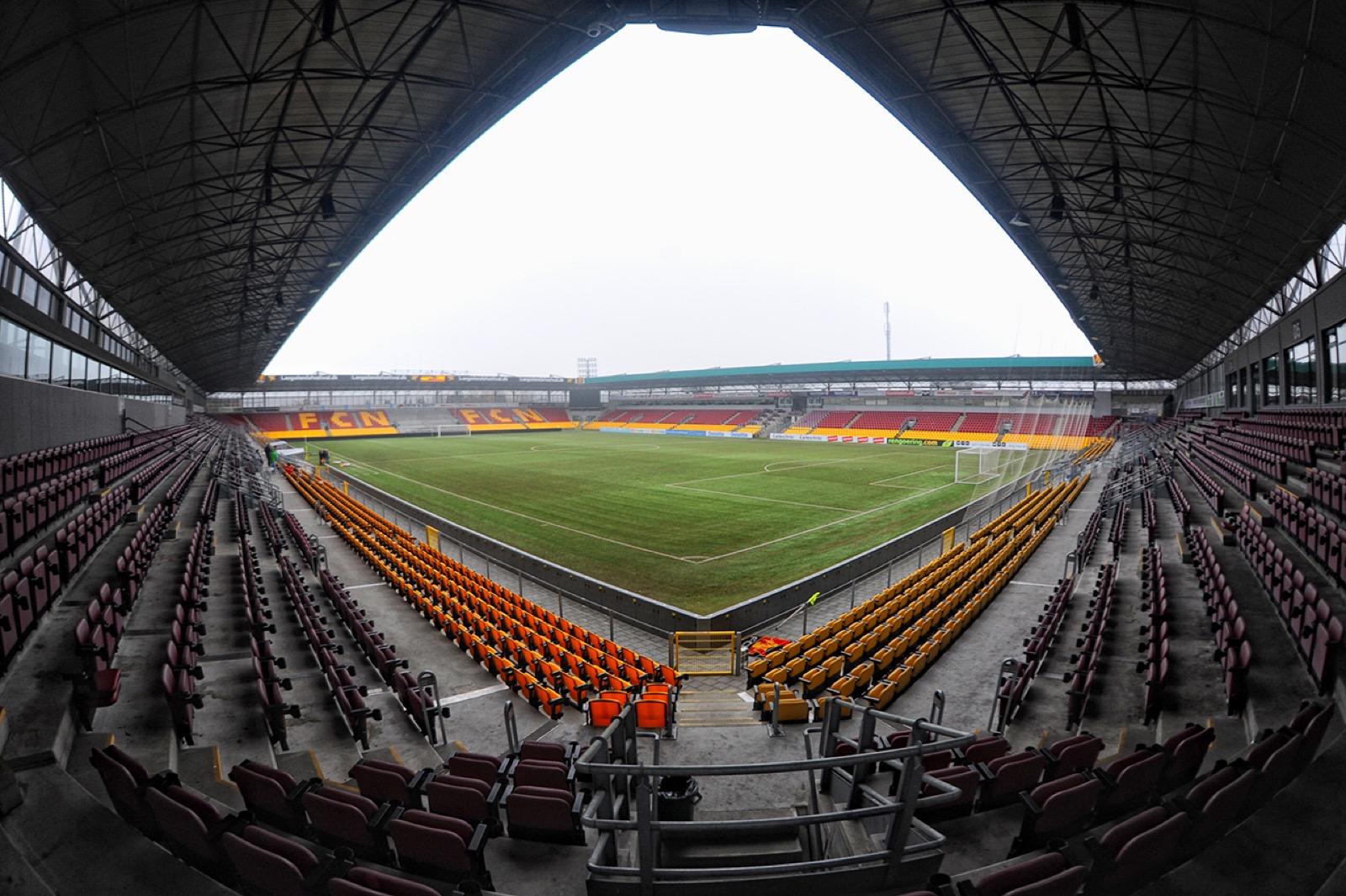
Farum Park in 2012, the year FC Nordsjælland won its only Danish championship. Three years later, the stadium and the club would be bought by a Ghanaian academy.
2012 · Валерий Дед — Wikimedia Commons · CC BY 3.0
Right to Dream
In 1999, an Englishman named Tom Vernon left his post as Manchester United's chief scout in Africa and founded, in Accra, a residential football academy. It was, at the origin, a single boarding school that welcomed children from across West Africa, spotted in local tournaments, and offered them full academic education in parallel to their football training. The structure was non-profit. The declared philosophy was that a football player is not a commodity, and that one has to form people before forming athletes.
For fifteen years, the Ghanaian academy operated as a closed system. It sent a few of its players to Europe through isolated contracts, without any control over their destination. Vernon quickly realised that the real limit of the model was not the quality of the training but the absence of an intermediate step between Accra and the Premier League. A young West African player who arrives directly at an English or French club often finds himself isolated, unprepared for European football, and his potential is lost in the shock of environment.
The December 2015 purchase of FC Nordsjælland is the structural solution to that problem. The Danish club becomes the controlled intermediate step: a European environment, a competitive championship, a professional infrastructure — but at a scale where a young player can grow without being crushed. Vernon becomes its president. The stadium, a few years later, is renamed Right to Dream Park.
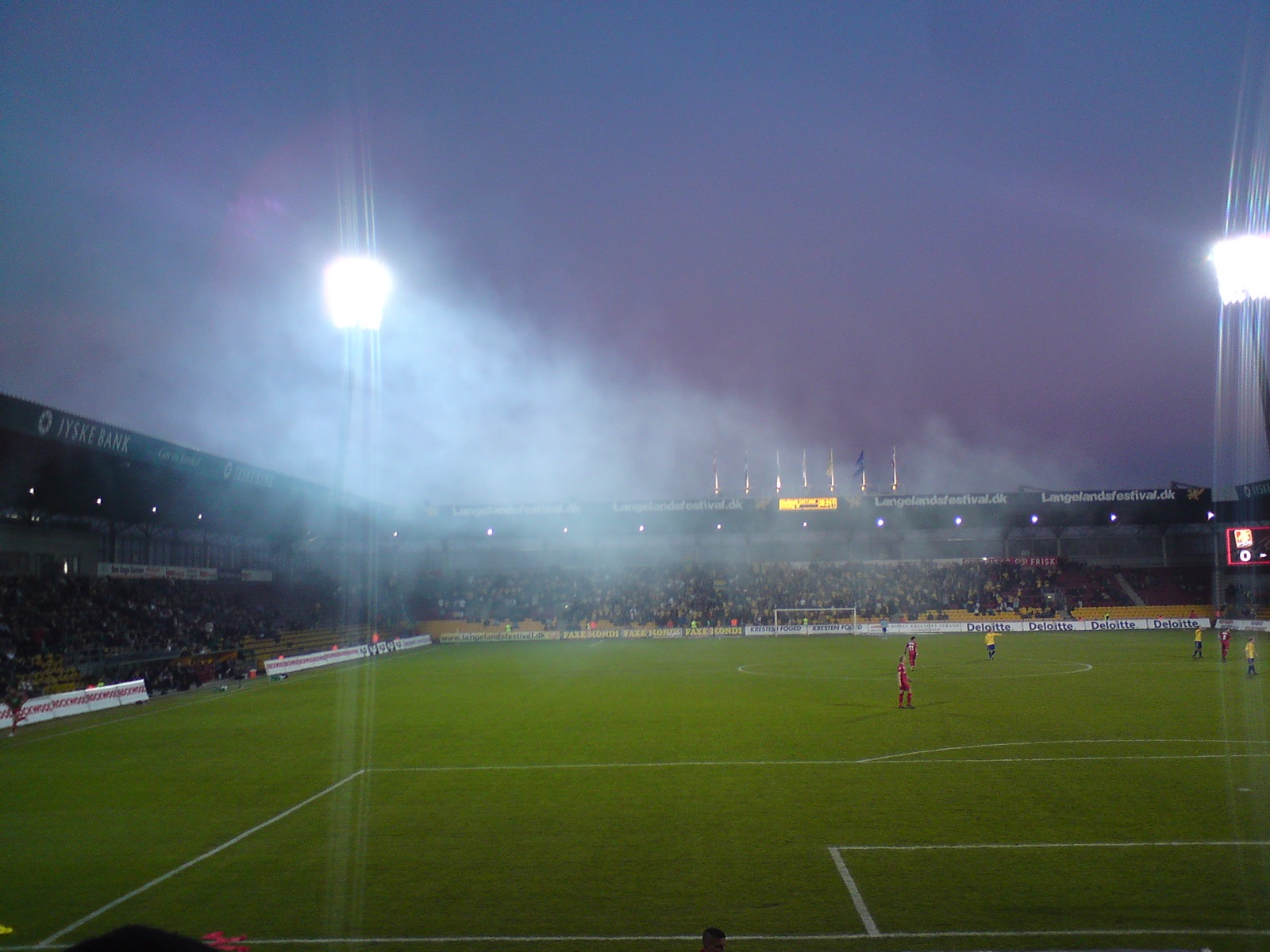
Farum Park during a match against Brøndby IF in April 2009 — six years before the Right to Dream purchase. The club was then a Danish outsider, with no identified international project.
Key figures
The purchase within the purchase
In 2021, Right to Dream entered a new phase. Man Capital, the British investment arm of the Mansour Group — an Egyptian family conglomerate run by the Mansour brothers, one of Africa's largest fortunes — invested one hundred million euros in a new partnership structure with Right to Dream. The original academy remained non-profit; but the entire system surrounding it became a commercial portfolio.
Concretely, from that operation, Right to Dream ceased being an academy and became a multi-academy, multi-club group. A new academy opened in Egypt, near Cairo. A club was created in Egypt, FC Masar. In the United States, the group founded San Diego FC, which joined the MLS in 2025. FC Nordsjælland remained the European tip. Tom Vernon remained president of the global group. For the first time, a vertical device linked a Ghanaian academy, a Danish club, an Egyptian club and an American club under the same ownership.
From a provincial club to a global system
- 1991
Club founded
Merger of Farum IK and Stavnsholt Boldklub under the name Farum BK, in the northern suburbs of Copenhagen.
- 1999
Tom Vernon founds Right to Dream
The former Manchester United chief scout in Africa opens a residential academy in Accra, Ghana.
- March 2003
Renamed FC Nordsjælland
Under Allan K. Pedersen, the club drops the Farum BK name and adopts a broader regional identity.
- 2011-2012
Danish champions
First and only Superliga title. Qualification for the Champions League group stage the following season.
- Dec. 2015
Bought by Right to Dream
First time a European club is bought by an African non-profit organisation. Tom Vernon becomes president.
- 2021
Mansour investment
Man Capital, the investment arm of the Egyptian Mansour Group, invests one hundred million euros in Right to Dream and structures a new multi-club group.
- 2025
San Diego FC joins the MLS
The fourth pole of the Right to Dream device becomes active in the United States. The system now spans three continents.
What the club has become
Under Right to Dream, FC Nordsjælland has won little — it regularly finishes in the top half of the Superliga, without claiming another title, and finished second in 2022-23. But that is no longer the criterion by which this club is evaluated. The criterion has become how many players developed here have reached the top of European football, and the answer is: a disproportionate number. The most famous is probably Mohammed Kudus, who went from Ghana to FCN to Ajax and now plays in the Premier League. He is not the only one.
The playing style of FCN is, since the purchase, openly oriented toward education: risks are taken, young players are played, defeats are accepted for the sake of individual progression. The historical Danish supporters — those who followed the club before 2015 — took time to accept that their team had become a development vehicle for mostly non-European players. But the sporting result did not collapse, the project has a visible meaning, and reconciliation has taken place gradually around a simple fact: since Right to Dream, FCN has never been in relegation danger.
The Danish club is no longer the destination. It has become the necessary passage between a West African academy and the top of European football.
What the model tells us
In the landscape of European club purchases, the FC Nordsjælland case holds a unique place. It is not a financial operation in the sense of a fund seeking a return on investment. It is not a brand operation in the sense of a billionaire seeking prestige. It is not even, originally, a sporting optimisation operation like Tony Bloom's at Union Saint-Gilloise. It is a human development operation structured vertically, with a European club as an intermediate step in a journey that begins elsewhere.
This inverts many categories. In the other multi-club models this report series examines, the European club is the high point, the destination, the goal. Here, it is the passage. The high point is the individual trajectory of a player, and the club is the tool. This inversion is not minor: it transforms the function of the club in its local ecosystem, it modifies the relationship to supporters, it changes the temporality of sporting decisions.
The risk of the model is precisely the 2021 arrival of the Mansour Group. The original Right to Dream academy has remained non-profit, but the group around it no longer is. An Egyptian family conglomerate now manages four entities across three continents, and the commercial logic will eventually collide, somewhere, with the educational logic that was at the origin of the project. For now — five years after the Man Capital investment — the tension is not yet visible. Tom Vernon is still there, the discourse has not changed, and the reputation of the model remains what justifies its existence. But five years, in football, is short.
For other European clubs, the transferable lesson is limited, because the model is almost impossible to reproduce — at its source, one needs a residential academy that has existed for twenty-six years and has accumulated a capital of trust impossible to fabricate quickly. But one thing is clear: FC Nordsjælland is the demonstration that a European club can serve a function that is not historically its own, and can do so without collapsing. That, in itself, is a change of category.